
Japanese language
About Japanese language

Kyoto Station of Shinkansen
Japanese language is spoken only in Japan.
It is called Nihongo (日本語) in Japanese.
It is said that there is no language linguistically similar to Japanese in the world.
The grammar is somewhat similar to Korean language, but Chinese language is quite different from Japanese.
The pronunciation of Japanese language is not so difficult.
Five vowels (A,I,U,E,O) are the base of the pronunciation.
But they are pronounced a little ambiguously.
And all Japanese syllables are only the following combinations.
1) Single vowel, 2) Consonant + Vowel, 3) Consonant + 'y' + Vowel, 4) Single 'n'
Therefore, when a Japanese word or sentence is written in the alphabet, about half of the characters are the vowels.
(For example, "Tokyo", "Hiroshima", "Kinkakuji", "Arigato" [=Thank you.], etc.)
Probably, it may be a little difficult for foreign people using the language with many consonants to pronounce the Japanese words with many vowels.

Signs with Japanese characters in Dotonbori in Osaka
Three types of character set are used properly for writing Japanese language.
They are hiragana (46 characters), katakana (46 characters) and kanji.
Hiragana and katakana express Japanese syllables.
Hiragana is the main character to write Japanese sentence, and katakana is used for writing loan words.
Kanji is Chinese character and 2,136 characters are used as the compulsory characters in Japan.
A kanji character has a specified meaning and readings, and it is used in the fitting Japanese word.
It is said that kanji characters account for 30% in the Japanese sentences.
The notation system using a lot of characters makes the learning of Japanese language difficult for foreigners.
In Japanese, the verb is put at the end of the sentence.
Auxiliary verbs are connected directly after the verb.
Verb, auxiliary verb and adjective have inflection, and the inflections are also confusing.
And, various honorific expressions are in the grammar and even Japanese people learn with difficulty.
But, the person who use the honorific expressions rightly is recognized as the man with common sense.
About Japanese language, please see the following pages.
Language for foreign tourists in Japan

Shops in Akihabara in Tokyo
Japanese language is essentially written in "hiragana".
But most of nouns, the stem of verbs and adjectives, etc. are written in "kanji" characters instead of "hiragana".
It is said that about 30% of total characters in a Japanese sentence are kanji characters.
And, the foreign words are written in "katakana".
Recently, new words of technology and culture are increasing, and "katakana" is used for the words.
When you travel around Japan, you will see mainly kanji and katakana characters on display boards, guide boards, etc. because they are mainly nouns.
But, for foreign tourists, alphabets, Chinese characters and Korean characters are added on the boards.
(Unfortunately, Arabic and Russian characters aren't seen.)
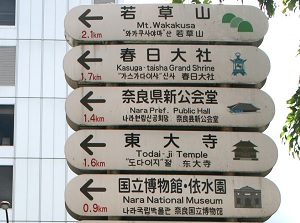
Guide boards in front of Nara station
In large cities or popular sightseeing spots, you can find English explanation on the brochures and guide boards.
Japanese people learn English from junior high school.
But many people are bad at English conversation.
Furthermore, the people who can speak the other language are rare.
But, when you must ask any question, please try to ask in English.
I think some Japanese people will answer you in unsteady English.
Let's use Japanese language
It is said that Japanese language is difficult.
But, words of greeting are useful in your travel.
Please see the following page.