
Japanese greetings
The vowel with a straight bar above a letter is pronounced long.
(e.g. "ō" = long "o")
1. Hai / Iie
Hai (はい) = yes
Iie (いいえ) = no
These are the words to answer a question.
Even if you don’t know them, the word of “yes” and “no” are OK in Japan.
2. Ohayō / Kon'nichiwa / Konbanwa
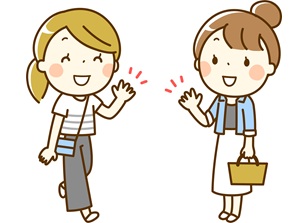
Ohayō. (おはよう) / Ohayō gozaimasu. (おはよう ございます) = Good morning.
Kon'nichiwa. (こんにちは) = Good afternoon.
Konbanwa. (こんばんは) = Good evening.
These are the most basic daily greetings.
“Ohayō” is used in early morning and “Kon'nichiwa” is used in the daytime.
The time when each person shifts from “Ohayō” to “Kon'nichiwa” is not fixed.
I think “Kon'nichiwa” is OK after around 10 a.m.
About the word of “Kon'nichiwa”, first “n” and next “ni” must be pronounced individually.
“Konbanwa” is used after dark.
When you use “Ohayō” in Japan, it is better to use “Ohayō gozaimasu”.
It is the formal sentence and “gozaimasu” is the verb group meaning politeness.
In Japan, “Ohayō” is used among family and familiar friends.
On the other hands, “Ohayō gozaimasu” is the common phrase in the other case.
In Japanese characters of “Kon-nichiwa” and “Konbanwa”, the last character is not “wa” but “ha” of Hiragana.
It is a particle of subject, and is a special notation.
3. Oyasumi

Oyasumi. (おやすみ) / Oyasumi nasai. (おやすみなさい) = Good night.
When we go to bed, we say “Oyasumi”.
It is also used among family and familiar friends, and the formal sentence “Oyasumi nasai” is used in the other case.
In addition, after you enjoy with your friends until the night, you can use this “Oyasumi nasai” when saying goodbye.
4. Hajimemashite
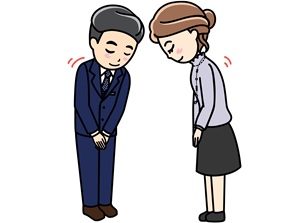
Hajimemashite. (はじめまして) = How do you do? / Nice to meet you.
When we meet a person for the first time, we say this.
Therefore, this may be a frequently used phrase when you work or study in Japan.
It is an only phrase, but there may be some ways of saying in English.
It is a little long word with 6 syllables, but please try to pronounce smoothly.
5. Sayōnara / Ogenki de
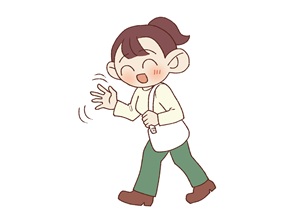
Sayōnara. (さようなら) = Good-bye. / See you.
Ogenki de. (お元気で) = Good luck.
When you say goodbye, common Japanese phrases are these.
“Sayōnara” is the normal word, but “Sayonara” with short "o" is often used when the other is familiar.
In the group of young people and children, “Bai-bai” from English is often used.
“Ogenki de” is a little more graceful phrase.
It means that the speaker hopes the other enjoys good health until they meet next time.
It is often used just after “Sayōnara”, and it is sometimes used instead of “Sayōnara”.
6. Arigatō
Arigatō. (ありがとう) = Thank you.
Arigatō gozaimasu. (ありがとうございます) = Thank you very much.
Arigatō gozaimashita. (ありがとうございました) = Thank you very much.
“Arigatō” is the most important phrase used when you express your thanks.
Only “Arigatō” is used in casual situation.
So, it is better for you to use “Arigatō gozaimasu” which is the formal sentence with verb group meaning politeness.
“Arigatō gozaimashita” is the past tense.
When the object of thanks was in the past, this form is more commonly used than “gozaimasu”.
7. Sumimasen / Gomen nasai
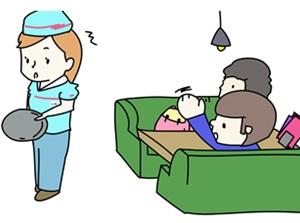
Westerner say that Japanese people often apologize.
It may be an extreme view, but it may be a little truth.
The symbol is a phrase “Sumimasen (すみません)”.
Let’s see a few specific scenes in a souvenir shop.
(a) I touched a cup on the shelf. It fell down and crashed. A clerk came.
(b) I want to pick a cup on the shelf up. I call a clerk.
(c) I want to pick a cup on the shelf up. I called a clerk. She picked the cup up and showed to me.
In English, “I’m sorry.” for (a), “Excuse me.” for (b), “Thank you.” for (c) are the best way of saying.
But in Japanese, “Sumimasen” is used commonly in all cases.
“Sumimasen” means that the speaker can’t solve the own problem and apologizes to the opponent for troubling.
The phrase with deep apologizing is used even in the scenes such as (b) and (c).
For Japanese people, it is bad to put the other to trouble.
Of course, it is good to say “Arigatō” (= Thank you.) in the scene (c).
It may be best for you.
In the scene (b), an adverb meaning short time is often add to “Sumimasen”.
“Chotto sumimasen (ちょっとすみません)” is also good phrase.
You can use this when you speak to a stranger to ask something.
In the scene (a), “Gomen nasai (ごめんなさい)” is also used instead of "Sumimasen".
This is a phrase of apology, so it can't be used in the scenes (b) and (c).
8. Itadaki masu / Gochisō-sama
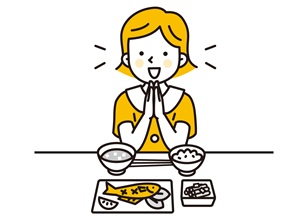
Itadaki masu. (いただきます) = Let’s eat.
Gochisō-sama. (ごちそうさま) / Gochisō-sama deshita. (ごちそうさまでした) = Thank you for the delicious meal.
Many Japanese people often say “Itadaki masu” putting their hands together just before they start eating.
At the end of a meal, they say “Gochisō-sama” and rise from table.
In Japan, these are the common custom.
All Japanese children are taught during school lunch time at elementary school.
“Itadaki masu” is the politeness expression of a verb “itadaku”.
“Itadaku” is a humble form of “morau” meaning “receive”.
Therefore, “itadaki masu” means receiving very humbly and graciously.
In fact, eating is to receive the life of animals and plants in nature for maintaining our life.
This phrase includes the mind of thanks to the animals and plants.
“Chisō” in “Gochisō-sama” means rushing from place to place to get foods for the guests.
The phrase includes the meaning that served meal is the work by the cooks who did so.
“Go” in the word makes the word polite, and “sama” at the end of the word means a honorific words for the person.
Totally, this phrase shows the thanks for the cooks.
Only “Gochisō-sama” is a form of noun, so it is elegant to say “Gochisō-sama deshita” with verb part of politeness.
9. Itte rasshai / Itte kimasu / Okaeri nasai / Tadaima

Itte rasshai. (行ってらっしゃい) = Bon voyage.
Itte kimasu. (行ってきます) = I’m going.
Tadaima. (ただいま) = I’m back.
Okaeri nasai. (お帰りなさい) = Welcome back.
These are a set of fixed phrases.
Similar English translation is given to above each Japanese phrase.
When family member or acquaintance goes somewhere, we send the person off by the word “Itte rasshai”.
The person say “Itte kimasu” at that time, and goes out.
However, the person saying "Itte rasshai" assumes that the person who goes out will surely come back.
Therefore, these words are basically used in the family or when a traveller staying in a hotel or ryokan goes out for a few hours.
When the person has come back and enters into the home, he says “Tadaima”.
We greet him using the phrase “Okaeri nasai”.
These phrases are used in the cases of not only trip to a distance but also various daily scenes.
Children go to school.
Member of family goes to work.
...
Probably, in any family, not a single day passes by without hearing about these phrases.
About “Okaeri nasai”, only “Okaeri” is also used often.
10. Omedetō

Omedetō. (おめでとう) / Omedetō gozaimsu. (おめでとう ございます) = Congratulations
This is the phrase that you congratulate someone.
The word such as “Tanjōbi (誕生日, birthday) ”, “Gokekkon (ご結婚, marriage) ”, “Yūshō (優勝, victory) ”, etc. is sometimes put before “Omedetō”.
When you say politely, “Omedetō gozaimasu” is good.
For new year, “Akemashite Omedetō gozaimsu” (明けましておめでとうございます) is a set phrase.
11. Phrases used in shop and restaurant

Japanese shop and restaurant staffs are generally courteous and put the customer first.
When you visit any shop or restaurant, you probably hear the following phrases by the clerk.
Please know the the meanings.
Irasshai mase. (いらっしゃいませ)
This is the phrase that the clerk calls at new visitor.
The meaning is "Welcome to our shop/restaurant!".
In sushi bar, for showing freshness, briskness and smartness, the sushi chefs call “Rasshai!” in short word.
Yōkoso. (ようこそ)
Recently, this phrase is often used by the clerk in many fast-food chains.
The meaning is almost equal to “Irasshai mase”.
Omatase shimasita. (お待たせしました)
When a shop clerk had you waiting or a restaurant waiter brought you a dish, they say this phrase.
It means “We have made you waiting”.
But this is a set phrase for the guest.
Arigatō gozaimashita. (ありがとうございました)
This is respectful phrase of "Thank you" as described above.
At the end of the service, the shop clerks often use this to thank their customers.