
Japanese language
Language for foreign tourists in Japan
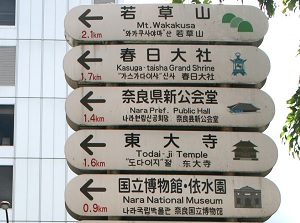
Guide boards in front of Nara station
Alphabetic characters are added on many guide boards in the town.
When you travel around Japan, you will see mainly Japanese characters on display boards, guide boards, etc.
For foreign tourists, Alphabetic characters are often added on the boards.
And, Chinese characters and Korean characters are seen on the boards.
(Unfortunately, Arabic and Russian characters aren't seen.)
In large cities or popular sightseeing spots, you can find English explanation on the brochures and guide boards.
Most Japanese people can't speak English
Japanese people learn English from upper grades of elementary school.
And they learn it during the school life.
But many people are bad at English conversation.
Because, most of them don't have the chance to speak English in Japan.
Only the people interact with foreign people can speak English.
Furthermore, the people who can speak the other language are rare.
But, most Japanese people know English.
When you must ask any question, try to ask in English.
Some Japanese people will answer you in unsteady English.
However, it may be useful to know what kind of language Japanese is.
What is Japanese language ?
Japanese language is spoken only in Japan.
It is called Nihongo (日本語) in Japanese.
It is said that there is no language linguistically similar to Japanese in the world.
Very many kinds of characters are used in Japanese.
There are three types of characters, and they are "Kanji" (Chinese character) and "Hiragana", "Katakana" made from Kanji.
Each of them is used properly.
The grammar is completely different from the other languages.
The pronunciation of Japanese language is not so difficult
Vowels
Pronunciation of words in Japanese is not so difficult.
Japanese has only 5 vowels.
Those are a, i, u, e, o.
These are the same as Spanish.
However, Japanese people don’t move their mouth so actively when they speak.
In most languages, “u” is pronounced with pursed lips.
But Japanese people don’t do so definitely.
Japanese “u” is a little obscure vowel.
Consonants
Basically, Japanese has only 14 consonants.
- Unvoiced : k, s, t, p, h
- Voiced : g, z, d, b, r, n, m
- Semivowel : y, w
Base of Japanese is "a consonant + a vowel"
In Japanese, the syllable is composed by the following rule.
- Single vowel (a, i, u, e, o)
- A consonant + A vowel (e.g. ka)
- A consonant + “y” + A vowel of "a","u","o" (e.g. kya)
- Single “n”
These are whole Japanese syllables.
As you can see, the pronunciation of Japanese is based on vowel.
The vowels combined by various consonants construct Japanese.
The detail of Japanese pronunciation and syllable is the following.
The writing system is difficult

Station sign of Kyoto station
There are three sets of characters for Japanese language.
They are Hiragana, Katakana, and Kanji (Chinese character).
These characters are mixed in accordance with the usage in Japanese sentence.
And, Japanese sentence can be written both horizontally and vertically.
Vertical writing is the traditional style, so newspaper and most books use the style.
Because the line is written from right to left, the first page of the book is on the right side.
Horizontal writing is mainly used in the documents created in computer and the books of science and technology using numeric characters, numerical expressions, foreign langage, etc.
Japanese notation on sign, guide plate, etc. can use both styles according to its shape.
Therefore, Japanese character is very convenient.
Hiragana

A child practices writing Hiragana
Hiragana is the basic character set for Japanese.
There are 46 characters.
Those were made with the cursive style of Kanji characters around the 9th century.
So, the character is formed by a few curve lines.
Hiragana is directly connected to the pronunciation.
So, all Japanese sentences can be written only in Hiragana.
In common Japanese sentences, stem of verb and adjective, and many of nouns are replaced to Kanji character as possible.
And, the other parts are written in Hiragana.
Many kanji characters are seen in the sentences, but the main character in Japanese is Hiragana.
Katakana

English words are written in Katakana
Katakana is another character set connecting to the pronunciation.
So, there are also 46 characters like Hiragana.
Those were made as the notation to read Chinese sentences with all Kanji characters around the 9th century.
So, the character is formed by a part of Kanji character.
Hiragana is the main character related to Japanese grammar, but Katakana is used to distinguish the special word in the sentence.
Commonly, the words which cannot be expressed in Japanese are written in Katakana.
- Foreign country name and place name
- Name of foreigner
- Direct notation of foreign word
- Name of organisms and mineral
- Expression of noise and animal call
Kanji

Kanji characters on guide plate in Tokyo station
Kanji is a Japanese word meaning Chinese character.
It was created in China in ancient times, and was introduced to Japan in the 5th or 6th century.
Each character has is formed by many lines, so the shape is complicated.
Each character has specific meaning and reading.
Therefore, a Kanji character may be like a word.
The number of the characters is countless, but 2,136 characters are selected as the compulsory Kanji characters which are taught in elementary and junior high school in Japan.
Most nouns and word stem of verbs and adjectives are written by Kanji as soon as possible.
So, you will see many Kanji characters in the town in Japan.
Punctuation marks
The punctuation marks in Japanese sentence are different from foreign language.
- Period (xx.) → XX。
- Comma (xx, xx) → XX、XX
- Quotation ("xx") → 「XX」
Simple Phrases in Japan
Before you study Japanese language, let's learn the Japanese greetings that you need not think about the grammar.
You should know the simple phrases such as "Thank you.", "Good morning.", etc. in English.
Lesson of basic Japanese
In Japanese, the verb is put at the end of the sentence.
Auxiliary verbs are connected directly after the verb.
Verb, auxiliary verb and adjective have inflection, and the inflections are also confusing.
And, various honorific expressions are in the grammar and even Japanese people learn with difficulty.
But, the person who use the honorific expressions rightly is recognized as the man with common sense.
If you are interesting in Japanese language, read the following pages.
You may know the overview of Japanese language.