
Pronunciation of Japanese
Vowels of Japanese
Japanese has only 5 vowels.
They are a, i, u, e and o.
Japanese people don’t move their mouth so actively when they speak.
In most languages, “u” is pronounced with pursed lips.
But Japanese people don’t do so definitely.
Japanese “u” is a little obscure vowel.
Consonants of Japanese
Japanese has only 14 consonants.
[unvoiced] k, s, t, p, h
[voiced] g, z, d, b, r, n, m
[semivowel] y, w
Above consonants are the base of Japanese language.
Additionally, the consonants of sh (ex."ship"), ch (ex."cheese"), j (ex."jump"), ts (ex."cats") in English are used as the changed ones.
"R" in Japanese is slightly different from "r" in English.
It is also different from "r" with a roll in Spanish.
It is nearly equal to "t" in "water" pronounced by native speaker of English.
You bring the tip of the tongue near the upper gum, then breathe out at the position.
That is "r" in Japanese.
By the way, Japanese doesn’t have the consonants of l, f, v which most languages have.
And Japanese doesn’t have special consonant such as th (ex."think", "that") in English.
Therefore, when Japanese people learn English, they aren’t good at the pronunciation of the words including such consonants.
Japanese syllable
In Japanese, the syllable is composed by the following rule.
- Single vowel (a, i, u, e, o)
- One consonant + One vowel (e.g. ka)
- One consonant + “y” + One vowel of "a","u","o" (e.g. kya)
- Single “n”
About No.3, the pronunciation is similar to the one including in the English words “cute”, “beautiful”, “news”, etc.
A semivowel "y" is inserted between consonant and vowel.
And, the vowels are only "a", "u" and "o".
The following tables have all combinations of Japanese syllable.
All Japanese words and sentenses consist of only the syllables.
| a | i | u | e | o | ||||
| ka | ki | ku | ke | ko | kya | kyu | kyo | |
| sa | shi | su | se | so | sha | shu | sho | |
| ta | chi | tsu | te | to | cha | chu | cho | |
| na | ni | nu | ne | no | nya | nyu | nyo | |
| ha | hi | fu | he | ho | hya | hyu | hyo | |
| ma | mi | mu | me | mo | mya | myu | myo | |
| ya | (i) | yu | (e) | yo | ||||
| ra | ri | ru | re | ro | rya | ryu | ryo | |
| wa | (i) | (u) | (e) | o | ||||
| n |
| ga | gi | gu | ge | go | gya | gyu | gyo | |
| za | ji | zu | ze | zo | ja | ju | jo | |
| da | ji | zu | de | do | ja | ju | jo | |
| ba | bi | bu | be | bo | bya | byu | byo | |
| pa | pi | pu | pe | po | pya | pyu | pyo |
Seion and Dakuon
There are two groups: Seion and Dakuon.
To put it briefly, "Seion" is unvoiced sound and "Dakuon" is voiced sound.
But, they are irreconcilable with the phonetics.
In Japanese, a syllable of Seion sometimes changes to a corresponding Dakuon by the connection of words.
(For example: Conveyor belt sushi,
"kaiten" (rotation) + "sushi" = "kaitenzushi")
Unused syllables
In the table, “yi”, “ye”, “wi”, “wu”, “we” are not used as modern Japanese.
They have changed to the vowels perfectly.
Changed consonants
The consonants in orange-colored syllables have been changed from the regular pronunciation through the centuries.
So, the pronunciations of “si” ,”ti”, “tu”, “zi”, “du”, etc. are not heard in current Japanese.
“Wo” is generally pronounced as “o”.
This syllable is used only as a particle.
Green-colored syllable “hu” is represented as “fu”.
The spelling has been usual quite a long time ago, but the consonant is not real "f".
Of course, it is a little different from “h”.
When you blow the candles, you purse your lips and blow a puff.
This is the pronunciation of Japanese “fu”.
Japanese pronunciation based on vowel
As above, Japanese language mainly consists of the syllables based on vowel, and single “N” appears sometimes.
Therefore, over three consecutive consonants never appear in Japanese.
The mouth and ear of Japanese people are accustomed to the pronunciation.
It is very hard for Japanese people to understand the pronunciation of the other languages including a lot of consecutive consonants.
For example, an English word “strength”.
It is one-syllable word, but Japanese speaker pronounces as…
“su-to-re-n-gu-su”.
Customarily, the mouth of Japanese speaker is apt to add a vowel to each consonant.
Pausing pronunciation
When foreign learners pronounce Japanese words, they are not good with this “pausing pronunciation”.
In Hokkaido Island, there is a big city Sapporo.
“Hokkaido” has two consecutive “k”, and “Sapporo” has two consecutive “p”.
The problem is how to pronounce these consonants.
When you pronounce “Hokkaido”, you pronounced “ho” and hold your bless for a moment in a pose that you pronounce next syllable “ka”.
After the brief moment of pause, pronounce “ka” soon.
About “Sapporo”, you apply the pause of pronunciation between “sa” and “po”.
This brief moment is very important.
For example, the following words are different.
saka [Jpn] = slope [Eng]
sakka [Jpn] = novelist [Eng]
ichi [Jpn] = 1 (one), position [Eng]
icchi [Jpn] = consensus, agreement [Eng]
oto [Jpn] = sound [Eng]
otto [Jpn] = husband [Eng]
When you speak Japanese, please pronounce each word in consideration of the existance of pausing pronunciation.
Long vowel
Basically, there is no long vowel in Japanese.
In English, for example, long vowel is distinguished between “sit” and “seat”.
Long vowels in Japanese appear when the speaker want to pronounce smoothly.
When two specific vowels are connected, a long vowel appears in the pronunciation.
The following two cases appear frequently.
When the long vowel is written in alphabet, a macron (¯) is added above the vowel character.
- 'o' + 'u' = Long 'o' (ō)
- 'e' + 'i' = Long 'e' (ē)
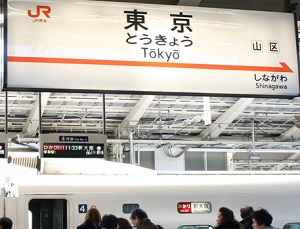
A sign of Tokyo station. The alphabet word has macron.
Probably, you surely visit Tokyo and Kyoto when you travel in Japan.
Actually, both words of “Tokyo” and “Kyoto” contain long vowels.
Both "o"s in "Tokyo" are long vowels.
The spell by original word is "Toukyou".
About "Kyoto", the former "o" is a long vowel and the latter "o" is a short vowel.
The spell of original word is "Kyouto".
Unfortunately, when we write Japanese words using alphabet, the notation of long vowel is left to the writer.
English is the major foreign language in Japan and has no special character like above characters with macron.
Therefore, when a word including the long "o" from "ou" is written, some writers use "ō" and the other writers use simple "o".
But, original spelling "ou" is rarely used customarily.
"Toukyou" is commonly written as "Tōkyō" or "Tokyo".
"Kyouto" is commonly written as "Kyōto" or "Kyoto".
On the other hand, when a word including the long "e" from "ei" is written, original "ei" is used in most cases.
"ē" is rarely used.
Even when the two same vowels are connected, a long vowel appears.
- 'a' + 'a' = Long 'a' (aa / ā)
- 'i' + 'i' = Long 'i' (ii / ī)
- 'u' + 'u' = Long 'u' (uu / ū)
- 'e' + 'e' = Long 'e' (ee / ē)
- 'o' + 'o' = Long 'o' (oo / ō)
In alphabet, writer can use the characters with macron.
But, customarily, the spelling of the two same characters is used in many cases.
Accent of Japanese
There is no accent in Japanese.
Basically, we pronounce consecutive Japanese syllables flowingly and with equal strength.
Instead we pronounce some syllables one octave higher than the other syllables.
And even in the same spelling, if the position of the pitch is different, the meaning is also different.
For example, "hashi"
HA (high) – SHI (low) : chopstick
HA (low) – SHI (high) : bridge
HA (high) – SHI (high) : edge
These are the pitches of standard language.
But in some dialect, the pitches are changed.
Therefore, you need not learn these for the time being.