
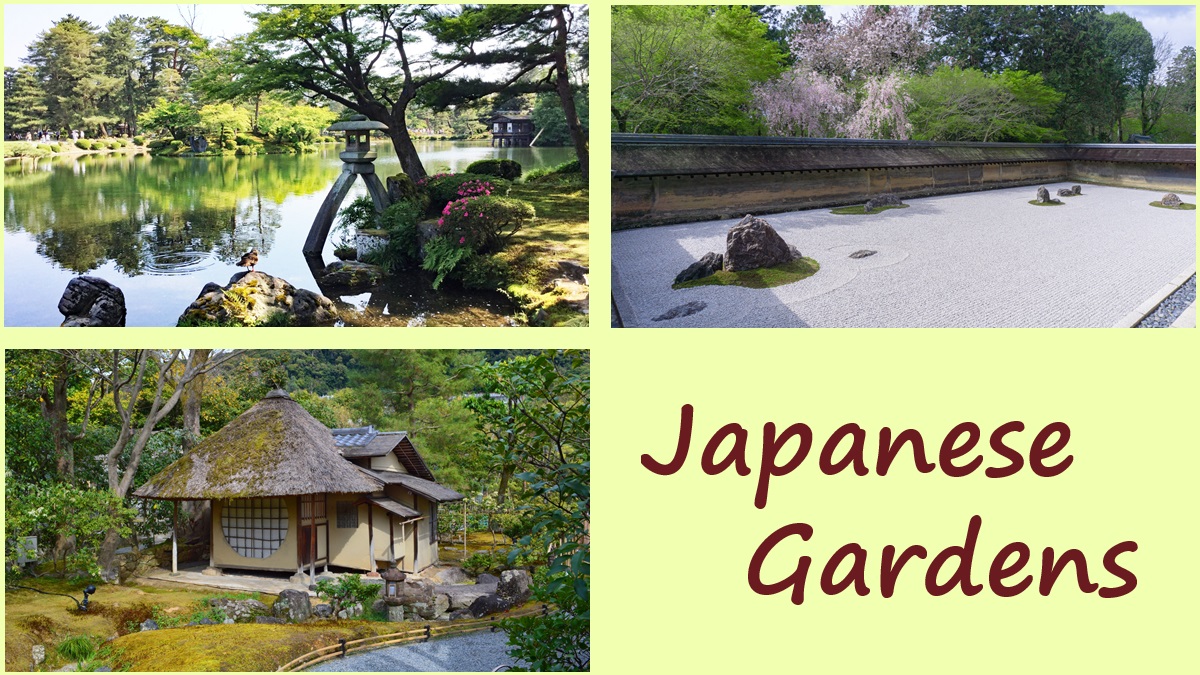
Japanese gardens
Three Great Gardens Gardens in Tokyo Gardens in Kyoto Popular gardens in Japan
About Japanese garden
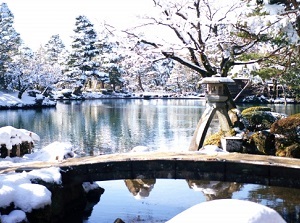
Kenrokuen in winter in Ishikawa Pref.
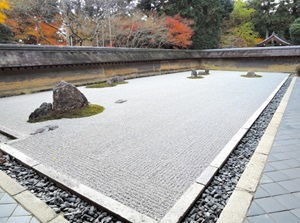
Sekitei garden of Ryoanji Temple in Kyoto
Japanese garden has been built as a yard of residence of high-ranking person, major Buddhist temple and Shinto shrine.
And, samurai lords in the middle ages built large garden in the site of the castle or the villa.
Japanese garden is a small world expressing beautiful nature.
Unlike western style garden, artificial and geometrical views are not seen.
Japanese garden may pursue the beauties of nature.
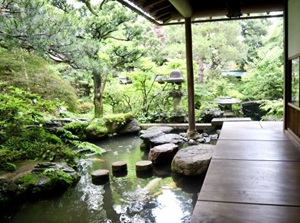
Japanese garden in Nomura family residence
(Kanazawa city)
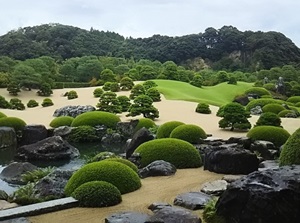
Japanese garden in Adachi Museum of Art
(Shimane Pref.)
In many gardens, a few ponds are placed in the center of the site, and stones, rocks, trees, streams, etc. are set around the pond.
In wide garden, walkways and arbors are set up.
The type of the garden is called "Chisen-teien" (池泉庭園) in Japanese, and it is simply translated as "Water garden" in English.
And, in some gardens, colorful Nishikigoi are kept in the pond.
Nishikigoi is a species of carp and had selective breeding artificially in Japan.
It is one of the items for beauty of the garden.
Some famous gardens are constructed by using the real background landscape such as far mountains, forests, castle, etc.
It is one of landscape gardening techniques in Japan, and it is called "Shakkei" (借景) in Japanese.
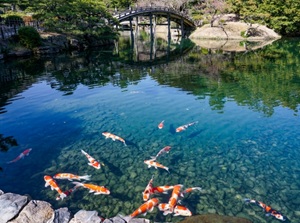
Nishikigoi in the pond of Ritsurin Park
(Kagawa Pref.)
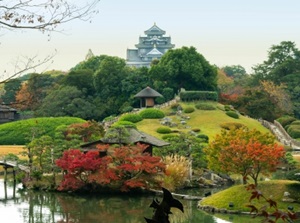
Korakuen with 'Shakkei' of Okayama Castle
(Okayama Pref.)
Another type is the garden without water, and it is called "Karesansui" (枯山水, Dry landscape).
The main part of garden is covered with white sand or gravel, and it expresses water such as sea, pond, river, etc.
And stones, rocks, trees, mosses, etc. are set up on or around it.
It is mainly seen in Zen Sect temples, so the view is abstract and meaningful.
You gaze quietly at the garden from a room, and you ask yourself what it means.
One more type of Japanese garden is "Roji" (露地, Teahouse garden).
Small garden is set up around the teahouse for the tea ceremony or on the places between the buildings in the residence.
When the visitors walk through there, they can enjoy the austere scenery.
Stepping stones to walk and water bowl to wash hands are set up in the garden.
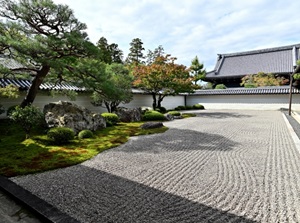
'Karesansui' garden in Nanzenji temple
(Kyoto Pref.)
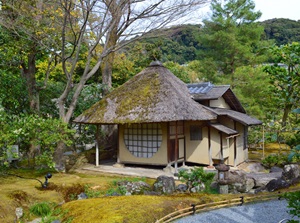
Teahouse and 'Roji' garden in Kodaiji
(Kyoto Pref.)
Three Great Gardens of Japan
Three Great Gardens of Japan is the most famous Japanese gardens.
It is said that these gardens had become popular since the end of the 19th century.
Kenrokuen (兼六園, Kanazawa city)
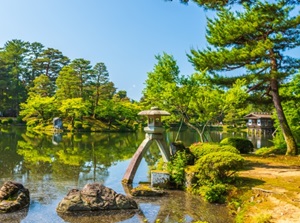
Kenrokuen is a garden in Kanazawa city in Ishikawa Prefecture.
It was built as the garden of Kanazawa Castle by the lord in 1676.
The castle and this garden was destroyed by fire in 1759, but this garden was reconstructed in the 1770s.
The garden was expanded in 1837, and the name of "Kenrokuen" was given.
In 1874, the garden was opened to the public.
Visitors can enjoy the scenery in all seasons, and snow in winter is also beautiful.
Korakuen (後楽園, Okayama city)
Korakuen is a garden in Okayama city in Okayama Prefecture.
It was built as the garden for the lord of Okayama Castle in 1700.
In 1871, the garden was opened to the public and the name of "Korakuen" was given.
The garden is located near Okayama Castle.
The castle and surrounding mountains are also included in the scenery of the garden.
Kairakuen (偕楽園, Mito city)
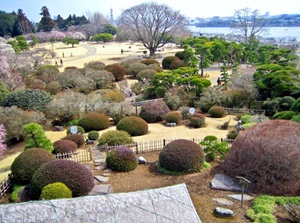
Kairakuen is a garden in Mito city in Ibaraki Prefecture.
It was built as a park for the people by the lord of Mito domain in 1842.
So, the garden is like a city park.
There are 3,000 trees of "ume" (Japanese aplicot or Japanese plum) in the wide part of the garden.
The season of the blossoms is from mid-January to March.
Popular gardens in Tokyo
Edo became a capital as political center in 1603.
The provincial lords all over the country set the second residence as a branch office in Edo period.
Powerful lords made a garden in the residence.
After feudal samurai period, Edo was renamed Tokyo in 1868.
Modern industry developed and Tokyo became the center of the Japanese economy.
Some large enterprises made a garden in the founder's residence as a symbol of wealth.
Such Japanese gardens are dotted in Tokyo.
Gardens in Tokyo Bay area
Hamarikyu Gardens (浜離宮恩賜庭園)
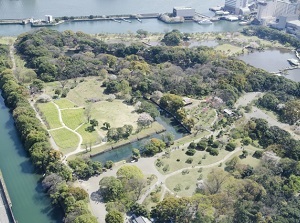
Hamarikyu Gardens faces Tokyo Bay and is near Shiodome district.
It was built as the garden in the villa of Shogun family in 1654.
It became a villa of the Emperor's family in 1868, and was granted to Tokyo Prefecture in 1945.
It has been opened to the public with charge since 1946.
There are a large seawater pond connected with Tokyo Bay and a few small ponds for duck hunting.
Kyu-Shibarikyu Gardens (旧芝離宮恩賜庭園)

Kyu-Shibarikyu Gardens is a garden to the south of Hamarikyu Gardens.
It was built as the garden of samurai residence in 1686.
It also became a villa of the Emperor's family in 1875.
The original garden was destroyed by the great earthquake in 1923, and the site became an evacuation center for the victims.
It was granted to Tokyo Prefecture in 1924 and was restored.
Current garen was opened to the public in 1931.
Gardens in central Tokyo
Koishikawa Korakuen (小石川後楽園)

Koishikawa Korakuen is a garden located near JR Iidabashi and Suidobashi stations in the center of Tokyo.
It was built as the garden of samurai residence of Mito Domain relating to Shogun family in 1629.
There are a large pond and some small ponds with islands and rocks.
It is unique that the garden involves elements of Chinese Confucianism.
Shinjuku Gyoen (新宿御苑)

Shinjuku Gyoen is a garden near Shinjuku district.
First agricultural experimental station was constructed in this site.
After the important works had been finished, current garden was built in 1906.
There are Japanese, British-style and French-style gardens, and the whole area is a natural park.
Rikugien (六義園)
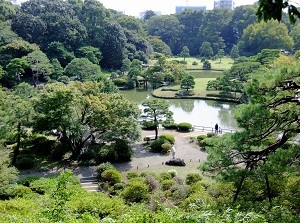
Rikugien is a garden located to the south JR Komagome station in the northern part of central Tokyo.
The garden was completed by an aide of Shogun in 1702.
It is said that the garden expresses the world of the Japanese poems created in the 10th century.
It was opened to the public in 1938.
Kyu-Furukawa Gardens (旧古河庭園)

Kyu-Furukawa Gardens are located to the north JR Komagome station in the northern part of central Tokyo.
It was built by a financial combine in 1917, and was opened to the public in 1956.
It is a garden of Western-style residence, and both Japanese style and Western style are mixed.
Former Yasuda Garden (旧安田庭園)

Former Yasuda Garden is located next to Ryogoku Arena for Sumo.
The garden was constructerd as the garden in a suburban residence of feudal lord in the early 19th century.
Yasuda company syndicate bought this garden in the 1880s, and the garden was open to the public in 1927.
The water in the pond is supplied from Sumida River.
Popular gardens in Kyoto
Kyoto was the capital of Japan from 794 to 1868, and many Buddhist temples were built from ancient times to the medieval period.
Most major temples have Japanese garden.
In some temples, we can enjoy views of the gardens of Karesansui type.
Very popular gardens are in the following temples and shrines.
Gardens of Buddhist temple in central Kyoto
Shosei-en (渉成園)

Shosei-en is the garden of Higashi-Honganji temple.
It is located just to the east of Higashi-Honganji and about 0.7 km from Kyoto station.
The garden was built in 1653.
It was used as a place where the chief priest secluded or guests.
The garden is 200 meters square.
There is a wide pond, and a few buildings are dotted around the pond.
Entoku-in (圓徳院)
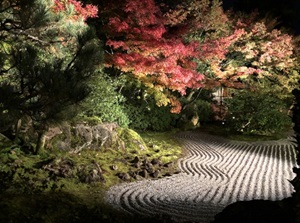
Photo by Kyoto Free Photo
Entoku-in is a small temple belonging to Kodaiji (高台寺) temple, and is located to the south of Gion district.
The temple was built in 1605, and Nene, a wife of Toyotomi Hideyoshi, spent her later years in the temple.
The garden is beautiful and is designated as a scenic beauty in Japan.
Kenninji (建仁寺)

Chouontei garden in Kenninji
Kenninji is a Zen Buddhist temple founded in 1202, and it is located in Gion area.
It is the oldest Zen temple in Kyoto and has the high social status.
There are two gardens in the temple.
Chouontei is a Japanese garden covered with moss.
Daiyuen is a Japanese stone garden.
Shoren-in (青蓮院)

Shoren-in is a Buddhist temple located to the northeast of Gion area.
The temple founded in 1150, and it was originally the residence for the high priests.
An emperor was converted to Buddhism and entered this temple, so it had been related to imperial family.
A few buildings are connected by corridors, and several garden are placed around the buildings.
Nanzenji (南禅寺)
Houjou-teien garden in Nanzenji
Nanzenji is a big Buddhist temple built in 1291.
It is the Zen temple with the highest social status in Japan.
There is a huge gate and the main temple is a National Treasure.
There are many old buildings in the wide site.
Various Japanese gardens are set up around the buildings.
Ginkakuji (銀閣寺)

Image of Ginkakuji
Ginkakuji is a Zen Buddhist temple located at the northeastern part of central Kyoto.
It was constructed as a villa of Shogun in 1482, and became a Buddhist temple after his death.
The main temple is a National Treasure.
There is the Japanese garden in front of the main temple and a part is unique geometrical garden called Ginshadan.
Daitokuji (大徳寺)

Garden in Zuiho-in by Daitokuji
Daitokuji is located in the northern part of central Kyoto city.
It was built in 1325.
There are many buildings, but there are also other 24 small temples in the site.
Visitors can enter the four temples (Ryogen-in, Zuiho-in, Koto-in and Daisen-in) of them, and each temple have the Japanese garden.
Ryoanji (龍安寺)

Ryoanji is a Buddhist temple founded in 1450 and it is located near Kinkakuji.
The Japanese garden "Sekitei" is the most famous garden of "Karesansui" type in Japan.
In the garden, 15 various rocks are arranged.
But, when we see this garden, we can find 14 rocks in our vision and only one rock is hidden at the back of these rocks.
Tofukuji (東福寺)

Tofukuji is a Buddhist temple located to the southeast of Kyoto station.
It was built in 1236.
There are many buildings in the wide site and several beautiful gardens are around them.
Four gardens around the main temple "Houjou" were constructed in 1939, and have unique geometric design.
Gardens of Buddhist temple in the suburbs of Kyoto
Shisendo (詩仙堂)
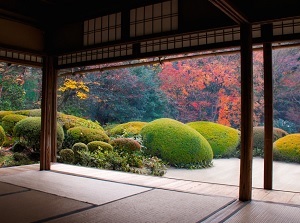
Shisendo is a Buddhist temple located in the northeastern area of central Kyoto.
It was originally a villa of a samurai built in 1641.
And, it became a Buddhist temple in 1966.
The samurai was a good designer of Japanese garden.
He designed to enjoy the changing seasons in this garden.
Ruriko-in (瑠璃光院)

Ruriko-in is a Buddhist temple and is located in the northeastern suburbs of central Kyoto.
The buildings was built as a villa in the 19th century and became a restaurant managed by Eizan Railway in 1942.
So it is near Yase-Hieisanguchi station of Eizan Railway.
And, in 2005, a Buddhist temple in Gifu Prefecture bought this building.
The scenic view of the garden from the villa is very popular.
It is opened for a limited time in spring, summer and autumn.
Tenryuji (天龍寺)

Tenryuji is a Zen Buddhist temple in Arashiyama area.
Originally, there was an Emperor's villa built in the 1250s in this site.
And it was changed this villa to the temple in 1345.
It is one of 17 constructions of Kyoto designated as World Heritage Site.
The garden with a wide pond is beautiful.
Saihoji (西芳寺)

Saihoji is a Buddhist temple located in the southwestern suburbs of central Kyoto.
The temple was founded in the 8th century.
It is famous for the garden covered with beautiful moss, so the temple is also called "Koke-dera (Moss Temple, 苔寺).
About 120 kinds of mosses are seen in the garden.
To visit the temple, a reservation must be made in advance.
Sanzen-in (三千院)
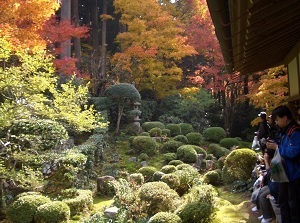
Sanzen-in is a very old Buddhist temple in Ohara district to the north of Kyoto.
It was founded in 788, and the buildings are in the forest.
In the middle ages, some priests and noble persons came to this area away from the hustle and bustle of the city.
This temple was one of the resting places.
There is a beautiful garden with the field of moss.
Gardens of Shinto shrine and Imperial Villa
Heian jingu (平安神宮)
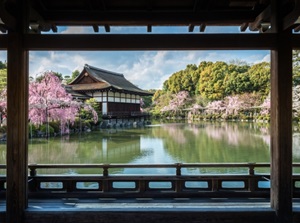
Heian jingu is a Shinto shrine located to the north og Gion district.
The shrine was built in 1895.
It was built as a part of the commemoration of the 1100th anniversary of transferring of the national capital from Nara to Kyoto in 794.
But, it was burned down in an arson attack in 1976, and was rebuilt in 1979.
Wide garden surrounds the main shrine and there are three ponds.
Shugakuin Imperial Villa (修学院離宮)

Shugakuin Imperial Villa is also one of the villas of Emperor Family, and is in the northeastern part of central Kyoto.
It was built at the direction of the emperor in the 1650s.
There are three areas with Japanese garden in the wide site and the common field spread between the gardens.
We must apply for visit to Imperial Household Agency in advance.
Katsura Imperial Villa (桂離宮)
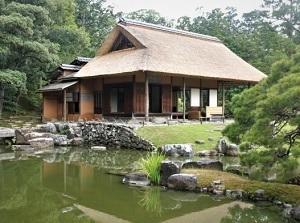
Katsura Imperial Villa is one of the villas of Emperor Family.
It is in the western suburb of central Kyoto.
Katsura River flows just east of this villa.
The villa was built in the early 17th century.
There is a wide pond in the center of the site and several buildings are around the pond.
The whole area is like a Japanese garden.
We must apply for visit to Imperial Household Agency in advance.
Popular gardens all over Japan
Sankeien (三渓園, Yokohama city)

Sankeien is in Yokohama city to sthe south of Tokyo.
It was opened in 1906.
The site is like an outdoor museum with moved and reconstructed old Japanese buildings of national important cultural property.
They are dotted in the wide site of Japanese garden.
Shirotori Garden (白鳥庭園, Nagoya city)

Photo by Nagoya Convention & Visitors Bureau
Shirotori Garden is a traditional Japanese garden opened in 1991.
It is located in Atsuta area in Nagoya city in Aichi Prefecture, and there is Atsuta Shrine near the garden.
A timber yard from ancient times had been closed, so this garden was constructed as a project of Nagoya city.
The wide garden about 200 meters square has big ponds, low hills, streams, waterfalls and various plants.
Yokokan Garden (養浩館庭園, Fukui Pref.)

Yokokan Garden is located in the center of Fukui city in Fukui Prefecture.
It was built in villa of the samurai lord of Fukui Castle in the 17th century.
The original buildings were destroyed by the air raid in World War II.
Wide pond spreads in the site and the Japanese houses by the pond are also beautiful.
Yuushien (由志園, Shimane Pref.)
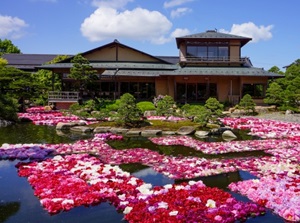
Yuushien is a garden park in a small island in Lake Nakaumi.
It is near Matsue city in Shimane Prefecture.
There is a pond and streams with waterfall flow into there.
Especially, this island is Japan's top producer of peony flower.
So, beautiful peonies are seen in this garden in spring.
Adachi Museum of Art (足立美術館, Shimane Pref.)
Adachi Museum of Art is an art museum in Yasugi city in Shimane Prefecture.
The museum exhibits Japanese-style paintings in recent and modern times.
Various types of Japanese garden are arranged around the museum.
They are ranked at the top in an American magazine "The Journal of Japanese Gardening" every year.
Ritsurin Garden (栗林公園, Kagawa Pref.)
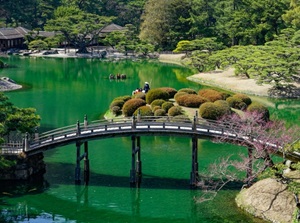
Ritsurin Garden is in Takamatsu city in Kagawa Prefecture.
It was originally a garden of a samurai house built in the 1680s.
The site of the garden is about 600 meters from north to south and about 300 meters from east to west in width, and there are many hills and ponds in the garden.
It is the largest gardens in Japan, and is designated as a nation's special place of scenic beauty.