
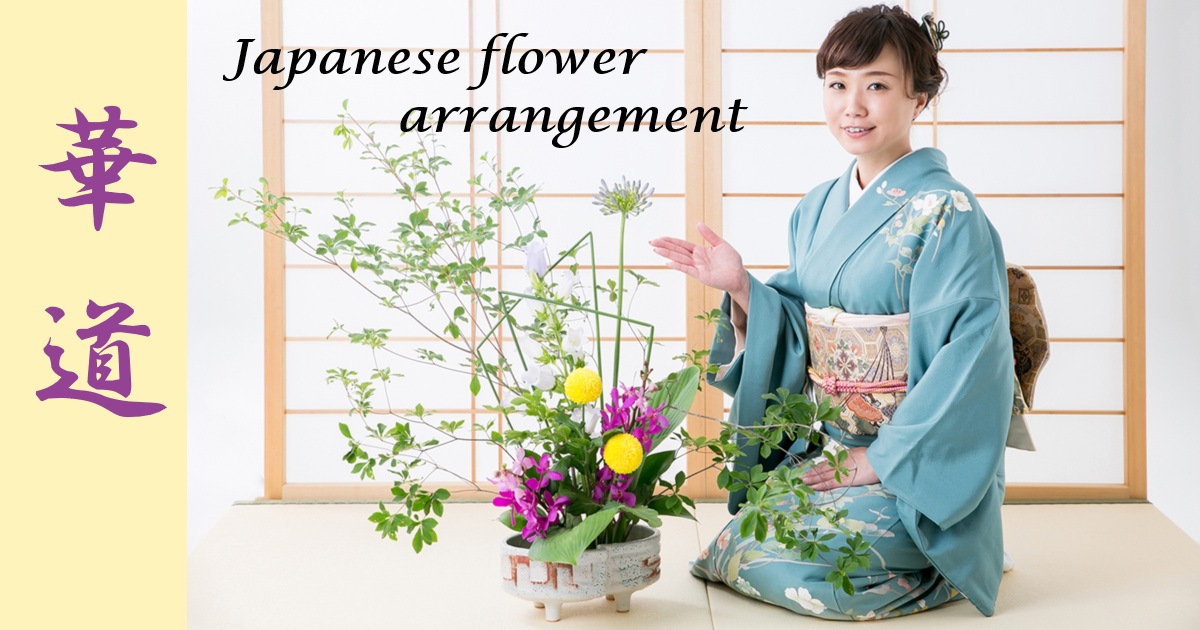
Japanese flower arrangement (Kado, Ikebana)
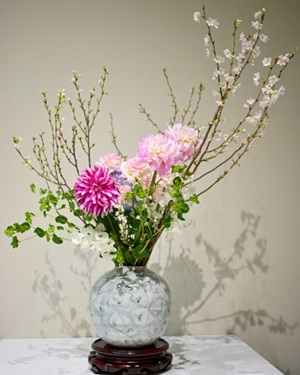
Flower arrangement in Japan is called Kado (華道).
The "o" in the word is pronounced as a long vowel like "Kadō".
"Ka" means "flower", and "Dō" is "way" and means undergoing training to master its essence.
Kado originated floral offering by Buddhist monks in Kyoto around the 15th century.
After that, it was spread in upper class people, and many schools were born.
In the early 19th century, it spread among ordinary people.
In addition, it was introduced to Europe in the 1860s.
Kado is an art achieved by training.
The creator makes a work according to the method and design of the school.
Another name meaning Japanese flower arrangement is Ikebana (生け花).
Ikebana means simply "flower arrangement".
Ikebana is a free work of flower arrangement using the method of a Kado school.
So, Kado is the work by flower arrangement expert, and Ikebana may be the work by common people.
Characteristics of Japanese flower arrangement
Western flower arrangement uses various colorful flowers and a lot of flowers are arranged symmetrically, beautifully and gorgeously.
It is mainly arranged to see from every angle, so it looks like an interior decoration.
On the other hand, in Japanese flower arrangement, only a few kind of plants are used.
The figures of the plants are expressed artistically, and the space made by the plants is also the object of the work.
It is mainly arranged to see from one side and is put against a plain wall, so it looks like a Japanese painting.
Flowers, blossoms, grasses, branches of tree, etc. are used, and a work is made by combining a few kinds of them.
For the vessel, various types of vase, basin, etc. are used, and the materials are pottery, glass, metal, lacquer ware, etc.
To make the plants stand on a flat vessel, pinholder called "kenzan" is also used as a tool.
Types of arrangement
Japanese flower arrangement has several styles of expression.
There are the styles with a long-standing historical tradition, as well as those created in modern times.
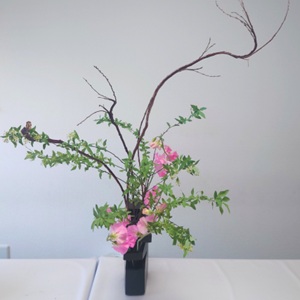
Rikka (立花)
Rikka is the oldest style of ikebana established around the 16th century.
In Rikka, trees symbolize mountains and grasses symbolize water within a single vase.
The arrangement expresses natural landscapes and the myriad phenomena of the universe.
The viewer looks at the artwork from the front.
There are 3 main branches, with 6 auxiliary branches arranged around them.
But, these are arranged asymmetrically overall, and that sense of natural imbalance is a defining characteristic of this style.
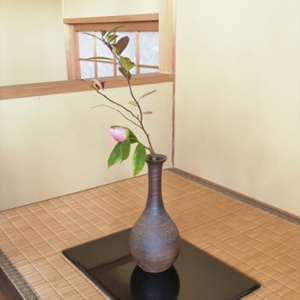
Chabana (茶花)
Tea ceremony was established around the 16th century.
Chabana originated as a style of flower arrangement Displayed in the tea room.
Based on the concept of "flowers as they appear in the wild" the wildflowers and plants blooming in the mountains and fields during that season are used.
But, the flowers with strong or unpleasant scents and with thorns or toxins are avoided.
In Rikka, the creator intentionally constructs the overall composition.
But, in Chabana, the flowers are simply placed in the vase in their natural form.
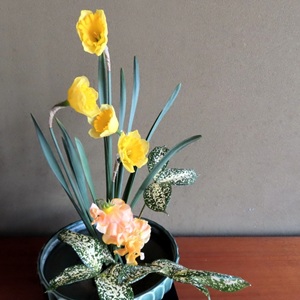
Shoka (生花)
Shoka was developed in the mid-18th century as a style that allowed for a more casual approach to flower arranging than Rikka.
"O" in the word is pronounced as a long vowel like "Shōka".
Only one to three types of flowers are used.
The flowers are arranged at three different heights: high, medium, and low.
And all the flowers are gathered together at the base.
Shoka expresses the scene that the plants live with their roots firmly planted in the ground.
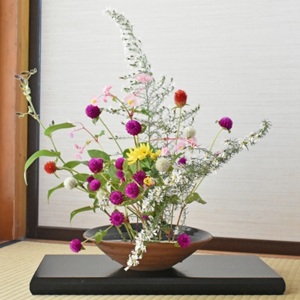
Moribana (盛花)
Moribana was devised in the latter half of the 19th century.
For Moribana, some flowers are arranged in a shallow, flat, and dish-like vessel rather than a deep vase.
To arrange flowers upright on the flat vessel, the tool called "Kenzan" which features numerous upward-facing needles is used.
Moribana expresses the expansiveness of nature or a waterside landscape by revealing the water's surface in the vessel.
The basic approach involves arranging flowers of three different lengths and inserting them into the Kenzan at varying angles.
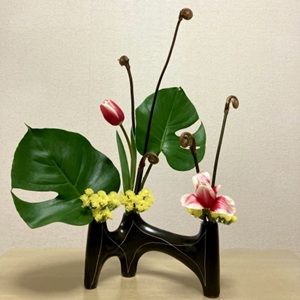
Jiyuka (自由花)
Jiyuka is a style of flower arrangement that the artist creates the work based on their own sensibilities without being bound by traditional styles.
"U" in the word is pronounced as a long vowel like "Jiyūka".
Jiyū means "free".
This is freestyle flower arrangement, so it began to be created after the 20th century.
Even with free-style flower arrangement, the completed work must be appreciated as a work of art.
The materials such as metal and plastic are used in addition to plants.
Seeing art of flower arrangement
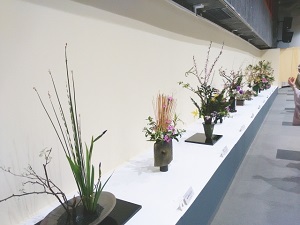
An exhibition of flower arrangement
Because live plants are used in flower arrangement, the lifetime of a work is very short.
So the works are sometimes exhibited for a limited time only in several galleries.
Then we can sometimes find it at hotel lobby etc. as original interior decor.
And, there are some major traditional schools of flower arrangement.
The official websires are the followings.