
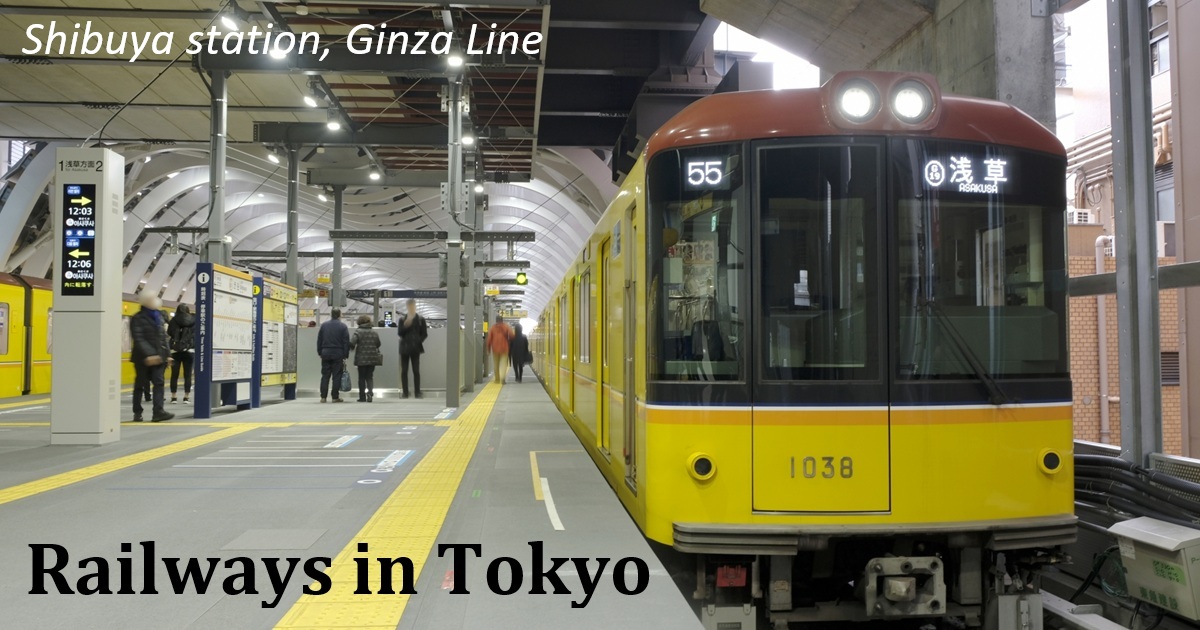
Railways in Tokyo
JR network in central Tokyo
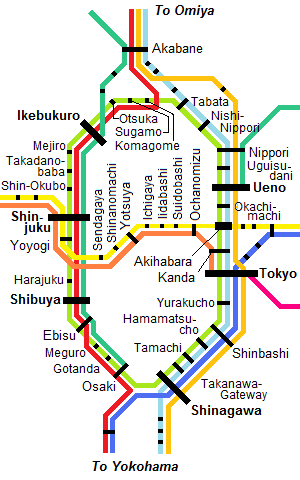
JR train network in central Tokyo
JR is the nationwide railway in Japan.
And, in central Tokyo, many commuter trains are operated frequently.
Because of JR, Japan Rail Pass is available.
Most JR lines run over the ground.
So we can catch the view of Tokyo from train windows.
When you walk around any town in Tokyo, the stations and running JR trains are good landmark objects.
As shown in the map, there is a loop line and some other lines in the area.
And, various routes of the train are set up.
The trains of most lines are operated from around 4:30 in the morning to around 1:00 late at night.
Each line has a symbolic color, and the cars of a line are painted its color.
Yamanote Line ●
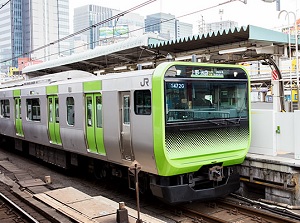
Train of Yamanote Line
Yamanote Line is a loop line running around the center of Tokyo.
The shape of the line is a long oval from north to south.
The total length is about 35 km, and it has 29 stations.
Both clockwise and counterclockwise trains are operated.
All trains stop at all stations.
The trains are operated every 3 to 5 minutes.
It takes about 65 minutes to go around the whole line.
This line passes some stations around the popular downtowns.
Main stations are Tokyo, Yurakucho (near Ginza), Shinbashi, Hamamatsucho (Transfer station to Haneda Airport), Shinagawa (Transfer station to Haneda Airport), Shibuya, Harajuku, Shinjuku, Ikubukuro, Ueno, Akihabara, clockwise.
Keihin-Tohoku Line ●
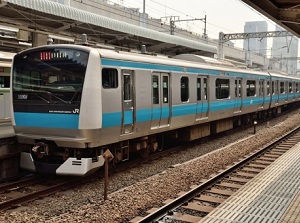
Train of Keihin-Tohoku Line
Keihin-Tohoku Line is a line running through central Tokyo from north to south.
It runs between Omiya in Saitama Prefecture and Ofuna in Kanagawa Prefecture.
The trains runs on the rail next to Yamanote Line between Tabata and Shinagawa.
You can change the train of Yamanote Line on the same platform in the section.
The trains are operated every 5 to 6 minutes in the daytime.
But they are operated every 2 to 3 minutes for the morning and evening commuting hours on weekdays.
From around 10:30 to around 15:30, all trains on this line are operated as "rapid train", between Tabata and Hamamatsucho.
The trains stop at only Ueno, Akihabara, Kanda, Tokyo in the section.
Chuo Line ●
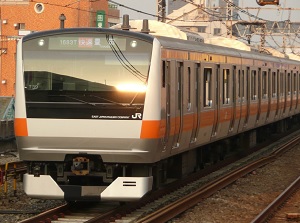
Train of Chuo Line
Chuo Line is a line from Tokyo station through Shinjuku to Tama area (western area) of Tokyo Metropolis such as Mitaka, Hachioji, Takao and Oume.
The line crosses the center of Yamanote loop line, so the passengers can go from Tokyo to Shinjuku in a short time.
The trains are all "rapid train" and are operated every 4 to 6 minutes.
The trains stops only at Tokyo, Kanda, Ochanomizu, Yotsuya and Shinjuku.
Local train of Chuo & Sobu Lines ●
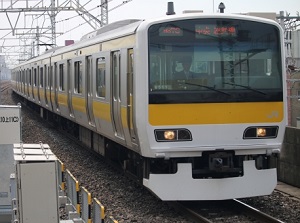
Train of Sobu Line
This is a line running from east to west through central Tokyo, and all trains stop at all stations.
It runs on the rail next to Chuo Line noted above toward western from Ochanomizu. It go to Mitaka.
The trains are operated every 4 to 6 minutes.
This line crosses over Yamanote and Keihin-Tohoku Lines at Akihabara station.
You can change the train there.
Other trains to go to the neighbouring prefectures
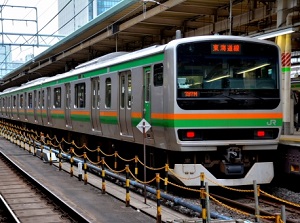
Train of Tokaido Line
Along the eastern side and western side of Yamanote Line, the trains to go to the neighbouring prefectures of Tokyo are operated.
These are the principal trains of JR.
The south part from Tokyo is Tokaido Line.
The trains stops at only Tokyo, Shinbashi and Shinagawa and go to Yokohama, Odawara and Atami.
The north part from Tokyo is Utsunomiya Line and Takasaki Line.
The trains stops at only Ueno, Oku and Akabane in Tokyo Metropolis.
These go to the cities in Saitama, Tochigi and Gunma Prefectures.
And there are also some other lines to the other directions.
Subway in Tokyo
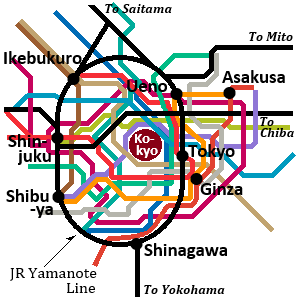
Subway network in central Tokyo
The area inside and around Yamanote Line is the central Tokyo.
As you can see the map, there are many subway lines densely in the area.
Kokyo (Imperial Palace) where the Emperor family reside is in the center of Tokyo.
Therefore, all subway lines are set up to take a detour around the wide site.
There are 13 lines of subway in the area.
These lines are operated by two companies.
One is Tokyo Metro, and it has 9 lines.
Another Toei, and it has 4 lines.
Toei is a local public enterprise operated by the Tokyo Metropolitan Government Bureau.
Commonly, both lines are displayed in subway route map.
But when you must change to a line of the other company on the way, you have to buy the ticket connecting the other company's line.
You may be confused a little when you buy the ticket at a subway station.
In addition, these companies of subway are not JR.
Therefore, "Japan Rail Pass" is not available for subway.
Line color, Line symbol and Station number
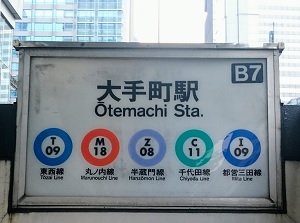
5 lines concentrate at Otemachi station
For foreign passengers, each line is assigned with a specific color, and each station is given a specific line code (one alphabetic character) and station number.
Of course, it is very good that you can memorize the station name in Japanese.
But when a station name is alphabetized, mostly it is a long word.
This numbering is very convenient for you.
Lines of Tokyo Metro
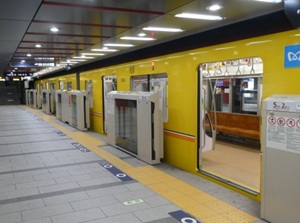
Asakusa station of Ginza Line with platform screen doors
- Ginza Line ●G
Asakusa, Ueno, Nihonbashi, Ginza, Shinbashi, Akasaka-mitsuke, Omote-sando, Shibuya - Marunouchi Line ●M
Ikebukuro, Korakuen, Otemachi, Tokyo (station), Ginza, Akasaka-mitsuke, Shinjuku, Nakano-sakaue, Ogikubo
(Branch line) ●m Nakano-sakaue, Honancho - Hibiya Line ●H
Kita-Senju, Ueno, Akihabara, Ningyocho, Ginza, Hibiya, Roppongi, Ebisu, Naka-Meguro - Tozai Line ●T
Nakano, Takadanobaba, Iidabashi, Otemachi, Nihonbashi, Monzen-nakacho, Urayasu, Nishi-Funabashi - Chiyoda Line ●C
Kita-Ayase, Kita-Senju, Nishi-Nippori, Yushima, Otemachi, Hibiya, Akasaka, Omote-sando, Meiji-Jingu-mae, Yoyogi-uehara - Yurakucho Line ●Y
Wako-shi - Ikebukuro - Iidabashi - Nagatacho - Yurakucho - Tsukishima - Shin-Kiba - Hanzomon Line ●Z
Shibuya, Omote-sando, Akasaka-mitsuke, Otemachi, Suitengu-mae, Oshiage - Nanboku Line ●N
Meguro, Shirokane-Takanawa, Akasaka-mitsuke, Iidabashi, Komagome, Akabane-iwabuchi - Fukutoshin Line ●F
Wako-shi, Ikebukuro, Shinjuku-sanchome, Shibuya
Lines of Toei
- Asakusa Line ●A
Nishi-Magome, Gotanda, Sengakuji, Mita, Higashi-Ginza, Asakusa, Oshiage - Mita Line ●I
Meguro, Mita, Hibiya, Otemachi, Jinbocho, Sugamo, Nishi-Takashimadaira - Shinjuku Line ●S
Shinjuku, Ichigaya, Jinbocho, Higashi-Nihonbashi, Ojima, Motoyawata - Ooedo Line ●E
Hikarigaoka, Tocho-mae, Shinjuku, Aoyama-itchome, Roppongi, Shiodome, Tsukishima, Ryogoku, Ueno-Okachimachi, Iidabashi, Tocho-mae
Railways around Tokyo Bay waterfront
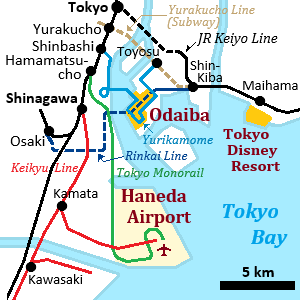
Tokyo Bay waterfront is an appealing area for tourist.
There is Tokyo Port near the central area of Tokyo, and some reclaimed islands are around the port.
Haneda Airport is located at the south end of this area.
Since the late 1990s, this area has developed rapidly, then many modern buildings and structures have been built.
This area is mostly occupied with landfill.
Therefore, monorail and Automated Guideway Transit are adopted for transport facilities because the facilities are light and the construction cost is cheap.
JR Keiyo Line ●
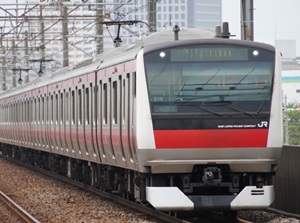
Keiyo Line is a JR line from Tokyo to Chiba along the Tokyo Bay.
The platforms in Tokyo station is set up deep under the ground, so it takes over 10 minutes to reach the platform.
There is Maihama station which is the nearest station of Tokyo Disney Resort (Tokyo Disneyland & Tokyo DisneySea).
The trains are operated every 4 to 7 minutes.
Because this is a JR line, Japan Rail Pass is available.
Tokyo Monorail
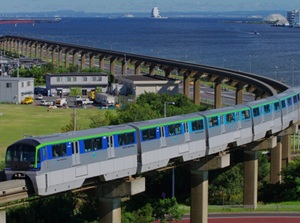
Tokyo Monorail running around Haneda Airport
Tokyo Monorail connects JR Hamamatsucho station of JR Yamanote Line and Haneda Airport
It is one of the method of transportation to the airport.
The total distance is 17.8 km, and it takes about 20 minutes from JR Hamamatsucho station to Haneda Airport.
In Haneda Airport, there are three stations: International Terminal, The 1st Terminal and The 2nd Terminal.
Exceptionally, Japan Rail Pass is available.
Yurikamome
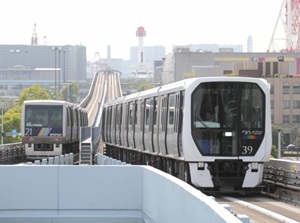
Yurikamome is an Automated Guideway Transit service opened in 1995.
The total length is 14.7 km and the starting station is Shinbashi in the central Tokyo.
It is in front of the east exit of JR Shinbashi station of Yamanote Line.
The train runs first along seaside area, then crosses Rainbow Bridge.
It reaches Odaiba area in a reclaimed island, and runs around the Odaiba area.
We can enjoy the good view all along the line.
The terminal station is Toyosu, and you can change to Yurakucho Line of Tokyo Metro (subway).
By the way, "Yurikamome" means "Black-headed Gull", and the nickname is the name of the line.
Rinkai Line
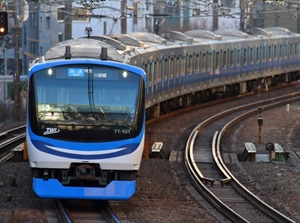
Rinkai Line is a railway connecting Osaki of JR Yamanote Line and Shin-Kiba of JR Keiyo Line and subway Yurakucho Line.
It runs through waterfront and Odaiba area.
The train runs underground, so we cannot see the view from the train.
Some trains from Rinkai Line go to Shibuya, Shinjuku, Ikebukuro etc. directly.
But, this railway company is not JR, so Japan Rail Pass is not available.
Railways having the lines to the suburbs of Tokyo
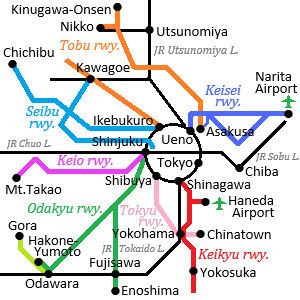
There are seven railway companies other than JR in Tokyo.
These have the lines from central Tokyo to the suburbs.
Many of the terminal station are located by the station of JR Yamanote Line.
Commuter trains are mainly operated frequently.
But, there are also some lines for sightseeing.
Of course, "Japan Rail Pass" is not available.
To Narita Airport - Keisei Railway
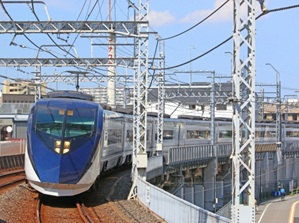
Keisei limited express, Skyliner
Keisei is a railway company with the lines to the east of central Tokyo.
The terminal station is in Ueno area, and limited expresses depart to Narita Airport.
And a branch line enters Toei Asakusa Line. Many trains from Narita Airport pass Asakusa and Ginza, and enter Keikyu Line to reach Haneda Airport.
For foreign passenger, a few discount tickets are sold.
Asakusa to Nikko - Tobu Railway
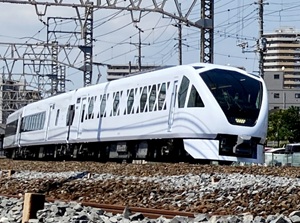
Tobu limited express, SPACIA X
Tobu is a railway company with the lines to the north of central Tokyo.
The terminal station is in Asakusa, and limited expresses depart to Nikko and Kinugawa-Onsen.
This line is the longest among the other railway companies in Tokyo, and it takes about 2 hours.
Because Nikko is a famous tourist attraction, Tobu sells a few discount passes.
There is another main line from JR Ikebukuro station.
It is a commuter line, but it leads to a popular old town Kawagoe.
To Kawagoe, Chichibu - Seibu Railway
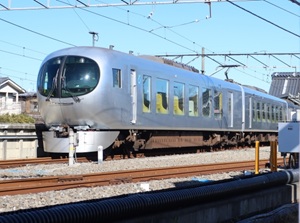
Seibu limited express, Laview
Seibu is a railway company with the lines to the west of central Tokyo.
Two main lines start from Shinjuku and Ikebukuro.
Ikebukuro terminal is beside JR Ikebukuro station of Yamanote Line.
Shinjuku terminal is a little way off JR Shinjuku station, and we can transfer to the line at next JR Takadannbaba station.
The popular spots of Seibu lines are Kawagoe and Chichibu area.
To Mount Takao - Keio Railway
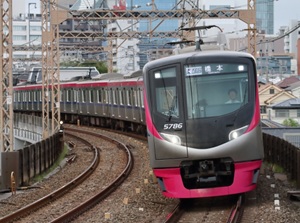
Keio commuter train
Keio is a railway company connecting Shinjuku in Tokyo and Hachioji and Hashimoto to the west of Tokyo.
Basically, all trains are commuter cars.
The main line connects Shinjuku, Hachioji and Mt.Takao.
And, a line to Hashimoto branch at Chofu station, and there is a popular amusement park Sanrio Puroland on the way. (The nearest station is Keio-Tama-Center.)
To Hakone - Odakyu Railway
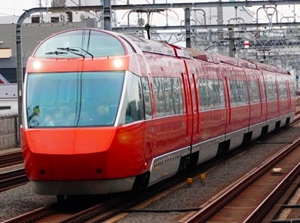
Odakyu limited express, Romancecar
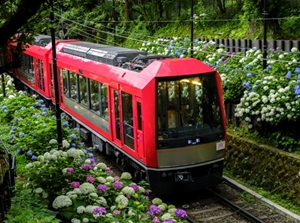
Hakone Tozan Railway
Odakyu is a railway company connecting Shinjuku in Tokyo and Odawara area to the southwest of Tokyo.
The main line connects Shinjuku, Odawara and Hakone-Yumoto.
Hakone-Yumoto is the entrance town of Hakone area.
In addition, from Odawara or Hakone-Yumoto, Hakone Tozan Railway climbs the mountain of Hakone to Gora.
So, Odakyu operates the limited express to Hakone-Yumoto one or twice an hour.
And it sells some discount passes to travel around Hakone.
Shibuya to Yokohama - Tokyu Railway
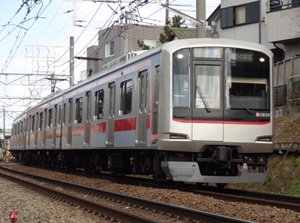
Tokyu commuter train
Tokyu is a railway company connecting Shibuya in Tokyo and Yokohama.
Basically, all trains are commuter cars.
The main line is "Toyoko Line", and it connects Shibuya, Minato-Mirai area and Chinatown in Yokohama.
From Shibuya, the line enters subway Fukutoshin Line (Tokyo Metro).
Many trains go to Meiji-jingu, Shinjuku and Ikebukuro.
To Haneda Airport, Yokohama - Keikyu Railway
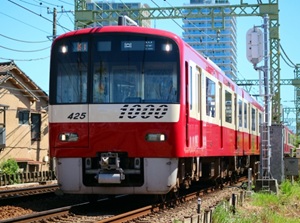
Keikyu commuter train
Keikyu is a railway company connecting Tokyo, Yokohama and Miura Peninsula at the end of Tokyo Bay.
It starts at Shinagawa of JR Yamanote Line, and goes to Haneda Airport, Yokohama and Yokosuka.
From Shinagawa, the line enters Toei Asakusa Line (subway).
Many trains go to Ginza and Asakusa and some trains go to Narita Airport by Keisei Line.
For foreign passenger, a few discount tickets for Keikyu and subway are sold.