
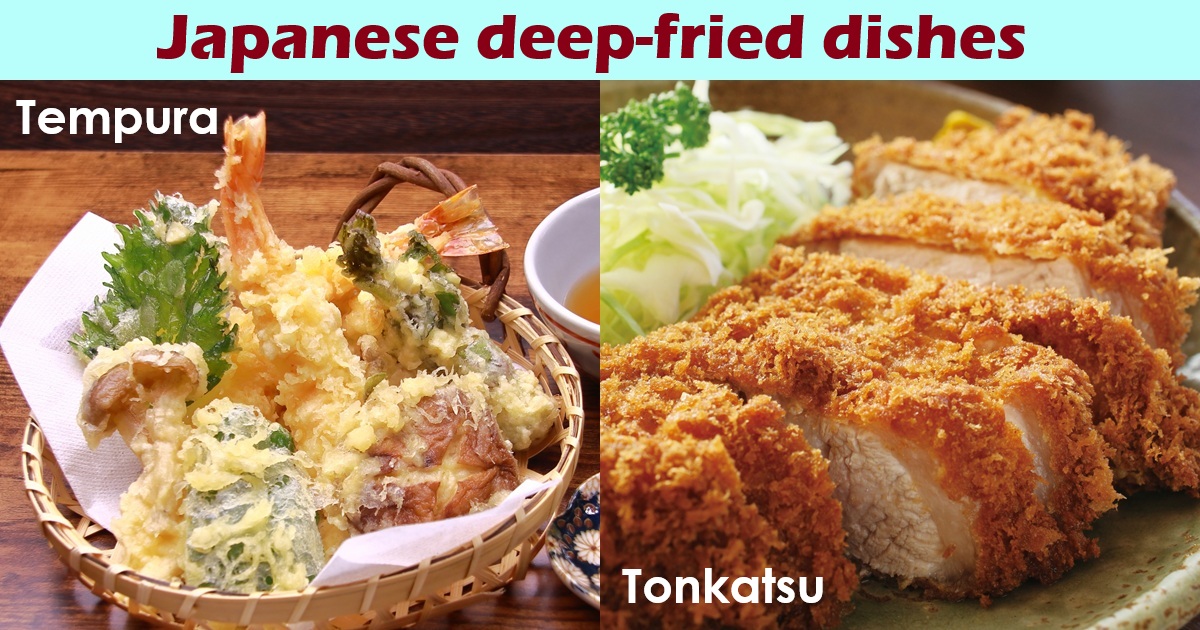
Japanese deep-fried dishes (Tempura, Tonkatsu)
Tempura

Tempura is a Japanese deep-fried dish that is popular among foreign tourists as well.
The batter is made from egg, cold water and wheat flour.
Seafoods and vegetables are coated in the thin batter and are deep-fried.
There is also a type of tempura made by gathering small pieces of vegetables and small shrimp, and frying them together as a round cluster.
This is specifically called "Kakiage".

Dipping tempura in tentsuyu
You can eat the freshly fried tempura by dipping it in "Tentsuyu" which is tempura dipping sauce made by mixing dashi, soy sauce and mirin.
Some restaurants serve salt instead of tentsuyu.
There are several high-end tempura specialty restaurants.
Japanese restaurants also offer tempura on their menus.

Tendon
Tendon is a Donburi (Rice bowl) dish.
Some pieces of tempura are topped on the rice in a donburi.
You can eat this at Japanese restaurants, and there are also fast-food chains specializing in Tendon.

Soba noodle topped with Kakiage
There are also udon and soba dishes topped with tempura.
You can eat this at a noodle restaurant.
It is said that Portuguese missionaries introduced it with Christianity in the 16th century.
It seems that the name "Tempura" originates from a Portuguese word.
Later, in the 17th century, Tempura spread among the common people in Edo (present-day Tokyo) as a dish of deep-fried fish.
Tonkatsu

Set menu of Tonkatsu
Tonkatsu is a dish made by coating a thickly sliced pork with flour, beaten egg and bread crumbs, and then deep-frying it.
"Ton" means "pig" and "Katsu" comes from the English word "cutlet".
Cutlet is made by pan-frying a thinly sliced meat in oil, but Tonkatsu is made by slowly deep-frying the meat in a generous amount of oil at a relatively low temperature.
Pork loin or tenderloin is used.
Tonkatsu made using loin meat is called Rosu-katsu, and one made using tenderloin meat is called Hire-katsu.
("O" in the word "rosu" is pronounced as a long vowel like "rōsu.")

Hirekatsu
At tonkatsu specialty restaurants, diners can choose either "Rosu" or "Hire".
"Hire" is more premium than "Rosu", so the price is slightly higher.
Tonkatsu is served cut into several pieces that can be picked up with chopsticks.
And, as a side dish, a mound of shredded cabbage is always served.
And, "Tonkatsu sauce" which is thick and sweet Worcestershire sauce is used for seasoning.
You can add mustard or sesame seeds to the sauce according to your taste.
There are many specialty tonkatsu restaurants across the country.

Katsudon
Katsudon is a Donburi (Rice bowl) dish.
Tonkatsu is simmered with thinly sliced onion in the broth made from dashi, soy sauce and sugar, and then bound with beaten egg.
That is placed along with the broth on the top of rice in the donburi.
You can eat this at Japanese restaurants, and there are also fast-food chains specializing in Katsudon.
In the late 19th century, "cutlet" was introduced from Europe.
In 1899, a Japanese restaurant invented Tonkatsu like cutlet of pork.
The cooking method of deep-frying by submerging the food in a generous amount of oil is based on the technique used for tempura.
Tonkatsu rapidly spread across the country as a Japanese-style Western dish.
Other deep-fried dishes
Katsu
"Katsu" in the word "Tonkatsu" refers to a deep-fried meat dish.
There are also a few dishes cooked with meats other than pork in the same method.

Chikinkatsu

Menchikatsu
Chikinkatsu is a dish made by coating a chicken with flour, beaten egg and bread crumbs, and then deep-frying it.
Menchikatsu is made by mixing ground pork and beef with finely chopped onion, shaping the mixture into a round patty, coating it in flour, beaten egg and bread crumbs, and deep-frying it.
These are inexpensive ingredients, so they are featured on lunch menus at dinners and are sold as ready-made side dishes in the stores for home consumption.

Kushikatsu in Osaka
Kushikatsu is a skewered fry of a few pieces of pork and vegetable.
It is also called Kushiage.
"Kushi" means bamboo skewer.
You can enjoy deep-fried dishes made with a wide variety of ingredients.
Generally, it is eaten after being dipped in Worcestershire sauce.
They are easy to eat on a skewer and allow you to enjoy a variety of ingredients, so you can often find it on izakaya menus.
In particular, Osaka City is known for having many standing-only Kushikatsu stalls.
Furai
The dishes prepared by applying tonkatsu frying method to seafood are called Furai rather than Katsu.
It is the Japanese pronunciation of the English word "fry".

Aji-furai, Ebi-furai

Kaki-furai
The most commonly used ingredients are "Aji" (horse mackerel), "Ebi" (prawn, shrimp), "Kaki" (oyster), "Ika" (squid).
As for the sauce, Worcestershire sauce is used just like with tonkatsu, but tartar sauce and Japanese soy sauce are also commonly used.
These are also featured on lunch menus at dinners and are sold as ready-made side dishes in the stores for home consumption.
Korokke

Korokke is a fry of mashed potato mixed chopped meat and onion.
The cooking method is the same as "furai" and "katsu", but the main ingredient is mashed potato.
The name "Korokke" came from "croquette" in French food.
Korokke is a cheap and tasty dish, so it is loved by everyone from children to adults.
It rarely appear on restaurant menus.
Instead, they are sold as prepared foods.
Karaage

Karaage of chicken
Karaage is made by lightly coating ingredients with flour and deep-frying them in hot oil.
Karaage of chicken is similar to "Fried Chicken".
Fried chicken gets its flavor from the spices in its batter.
But Japanese karaage is seasoned with soy sauce and other flavorings in the meat before frying.

Tatsuta-age of a fish
Wheat flour is used as the powder.
But, when potato starch is used, it becomes a unique Japanese fried dish called Tatsuta-age.
Compared to Karaage, tatsuta-age is characterized by a crispy texture, with the potato starch remaining as a patchy white coating on the surface of the ingredients.
Tatsuta-age can be applied not only to chicken but also to fish such as mackerel.