
Aomori Prefecture [青森]
Outline of Aomori Prefecture
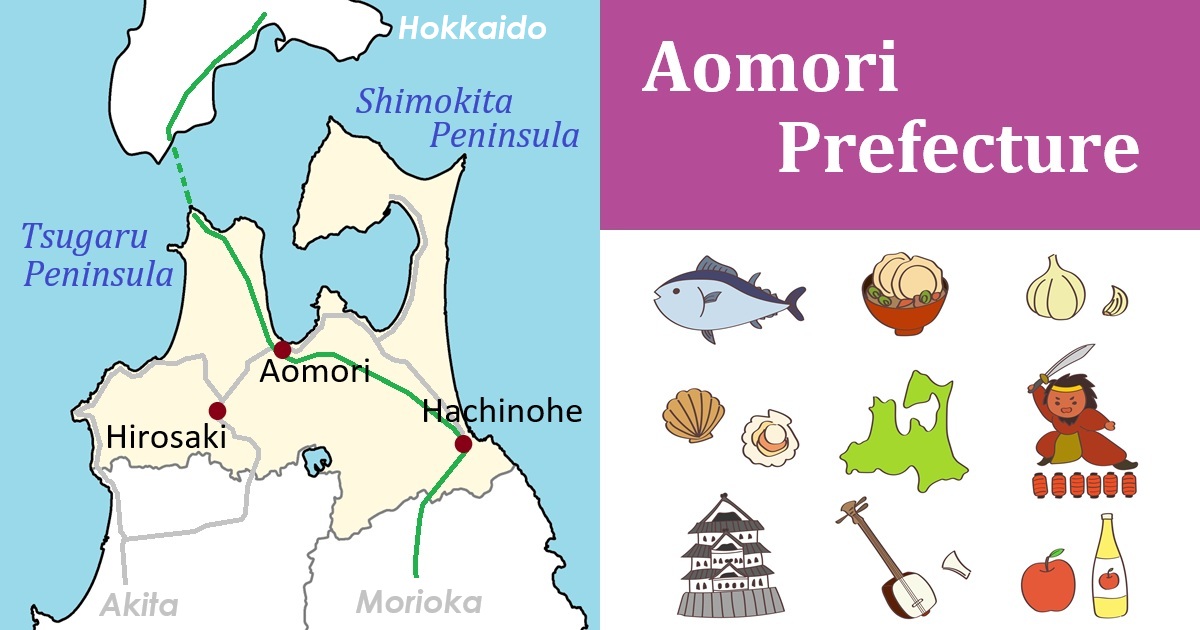
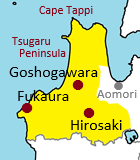
Aomori Prefecture is the northernmost prefecture in Honshu island.
There is Hokkaido island to the north across Tsugaru Strait
Two large peninsulas extend from the north coast.
The eastern side is Shimokita Peninsula shaped like an ax.
The western side is Tsugaru Peninsula.
There is Mutsu Bay between these peninsulas.
Especially, the southwestern part of the bay is called as Aomori Bay.
And the eastern coast faces the Pacific Ocean, and the western coast faces the Sea of Japan.
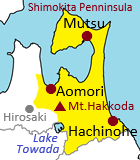
The central city is Aomori city, and it is located on the northern coast at head of Aomori Bay.
It is a gateway to Hokkaido via rail and ship.
Generally, the western half of the prefecture is called as Tsugaru area, and the eastern half is called as Nanbu area.
In winter, most areas in the prefecture have much snow.
Especially, Tsugaru area is a heavy snowfall area.
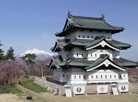
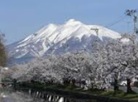
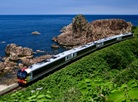
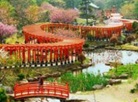
Tourist spots in Aomori Prefecture
Aomori city & Nanbu area
Tsugaru area

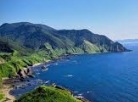
Local foods in Aomori Prefecture
Senbei-jiru
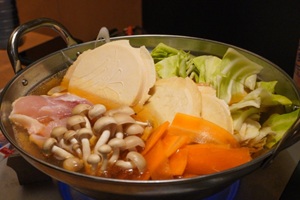
Senbei-jiri is a specialty dish from Hachinohe city in the eastern area of Aomori Prefecture.
Japanese Dashi stock is poured into a pot, and gobo (burdock root), carrots, mushrooms and chicken are simmered.
Senbei are cracker-like snacks made by mixing wheat flour with water and baking the mixture into a round shape.
The Senbei is broken into pieces and added to the pot mentioned earlier.
They soak up the delicious broth and take on a texture similar to pasta.
You can enjoy Senbei-jiru at the restaurants and izakaya (Japanese pub) in Hachinohe city.
Towada Bara-yaki
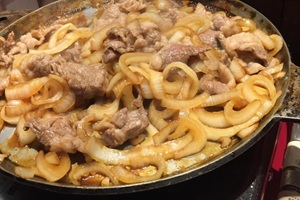
A large amount of thinly sliced onion and beef brisket are stir-fried on a hot iron plate in a sweet and savory soy-based sauce.
This is "Bara-yaki".
"Bara" means brisket and "yaki" means frying in Japanese.
This dish was invented in the area around Towada city where Lake Towada is located.
You can enjoy this dish at the restaurants in central Towada city, but it is also available at restaurants around Lake Towada which is located some distance away.
Kaiyaki-miso
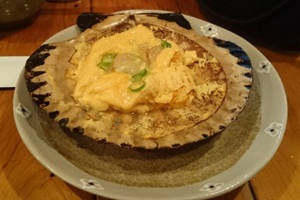
A scallop shell about 20 cm in size is used as a pot.
Fish fillets and vegetables are placed on the shell, "miso" is added, and the shell is grilled over a fire.
Scallops were abundantly harvested in Mutsu Bay surrounded by two large peninsulas.
It is said that local fishermen have long prepared dishes in this style.
You can currently enjoy this dish at restaurants on the Shimokita Peninsula and in the Tsugaru region.
Jappa-jiru
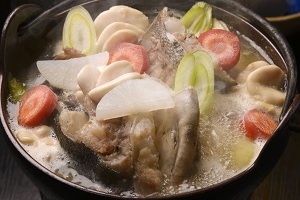
Jappa-jiru is a fish stew cooked in miso soup.
Jappa means "remain" in Aomori dialect, then main ingredients are the head, guts, fishbone and other parts of fish except the fillet.
In short, the parts of fish which are normally thrown away are used.
Generally a codfish is used.
The parts of a codfish are cut into chunks, and are stewed with a few kind of vegetables such as daikon (Japaanese radish), hakusai (Chinese cabbage) and negi (green onion) in miso soup.
You can enjoy this dish at izakayas (Japanese pub) and restaurants serving local cuisine in Aomori city.
Ichigo-ni
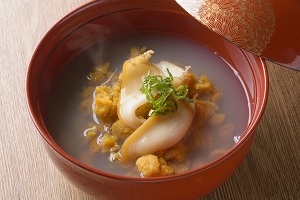
Ichigo means "strawberry" in Japanese.
But ichigo-ni is not the dish of strawberry.
It is a clear soup with uni (sea urchin) and abalone, and the seasoning is only small amount of salt and shoyu (soy sauce).
Commonly chopped green perilla (Japanese basil) is added for flavoring.
Uni and abalone are very expensive, but this dish has been cooked using unsalable ones by fishermen.
A gracious man said that the orange uni looks like wild strawberries in the morning haze, then it is said that this dish got the name.
This is a local dish around Pacific Ocean coastline in eastern Aomori Prefecture.
So, you can eat it at the restaurants in Hachinohe City and the towns along the Pacific coast to the south of Hachinohe.
Local specialties in Aomori Prefecture
Apples
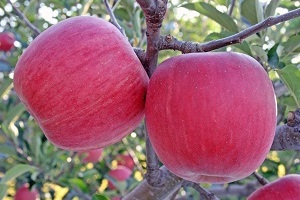
Apple is the most popular agricultural product in Aomori Prefecture.
The amount of production accounts for half of Japan's total harvest.
The apples are cultivated mainly in western part of Aomori Prefecture around Hirosaki. (Tsugaru area)
A lot of apples from Aomori are exported to Taiwan, Hong Kong, China and some other countries.
Especially, it is said that Taiwan people values highly Japanese apples.
Tsugaru-nuri (Tsugaru lacquerware)
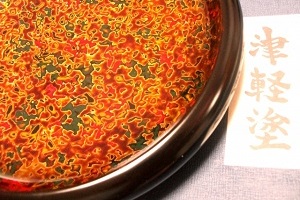
Tsugaru-nuri is a lacquerware produced in Tsugaru area.
Main producing area is Hirosaki city.
It is that the feudal lord in Tsugaru started encouragement to develop the industry in 1646.
Lacquering and polishing are repeated again and again.
It takes over two months and more than 40 steps to complete the product.
Therefore, the product is beautiful and durable.