
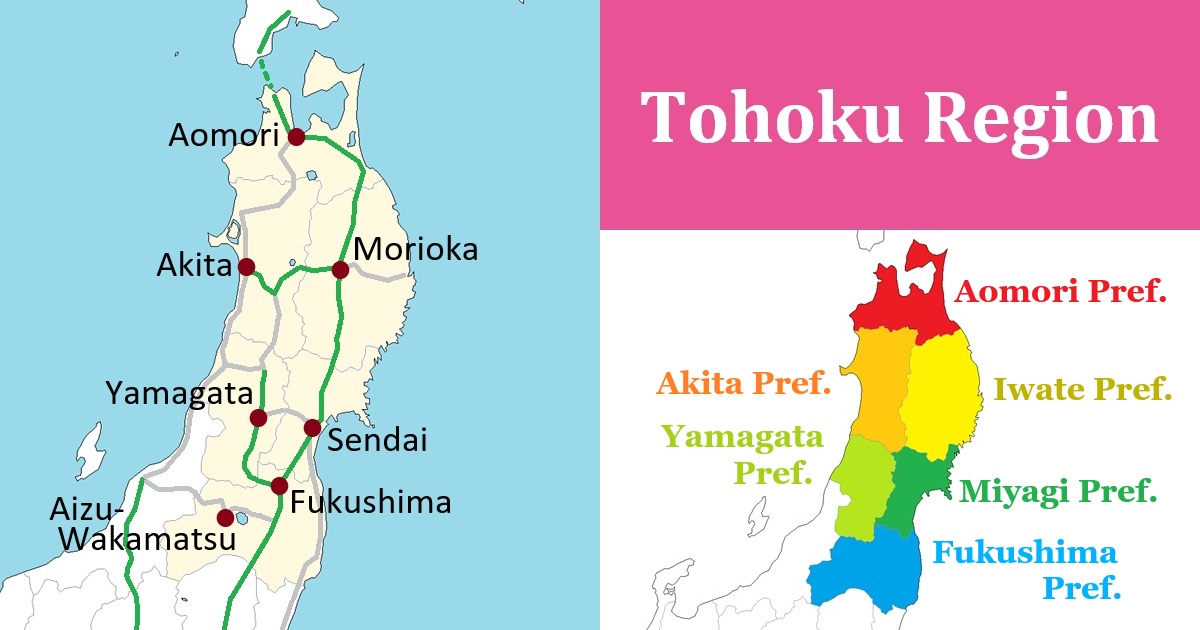
Tohoku Region [東北]
Outline of Tohoku Region
Tohoku Region is the north part of Honshu Island in Japan.
The first "o" in "Tohoku" is pronounced long, so it is read as "Tōhoku" in Japanese.
The area extends north and south, and the distance is about 500 km.
There is Hokkaido Island to the north beyond Tsugaru Strait.
Seikan undersea tunnel connects Honshu Island and Hokkaido Island.
The west side of the region faces to the Sea of Japan, and the east side faces to the Pacific Ocean.
This area is mountainous, but only a few mountains are over 2000 meters high.
From the north to the south, 18 active volcanoes are dotted in this region.
Because this region is located in the north part of Honshu Island, the climate is cooler than the other area.
In winter, much snow fall in most areas on the Sea of Japan side by the wet air from the northwest.
But the areas facing to the Pacific Ocean has not so much snow.
Therefore, winter comes earlier and spring comes later than the other areas in Honshu Island.
On the other hand, it is often as hot as the other areas in summer.
The main industry of Tohoku Region is agriculture.
Especially, Tohoku region is one of major rice‐producing areas in Japan, so tasty rice is harvested in whole areas of Tohoku.
Various fruits are created in some areas of this region.
Apples in Aomori, cherries in Yamagata, and peaches in Fukushima are very famous.
In addition, because tasty rice is produced, there are many delicious Sake breweries in this region.
Tohoku is also a region that various traditional crafts have been created for several centuries.
In some cities and towns, high-quality products for daily life are made.
The Great East Japan Earthquake occured on March 11, 2011.
The earthquake shook the whole areas in Tohoku Region terribly.
Then, huge tsunami attacked the all coast facing to the Pacific Ocean in Tohoku Region.
By the catastrophe, more than 18,000 people were left dead or missing.
In addition, because Fukushima nuclear power plant was damaged by the tsunami, the areas around the plant were contaminated by radioactivity.
The damaged areas has largely recovered.
Guide of each prefecture Tohoku Region
Aomori Prefecture
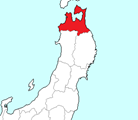
There is Hokkaido to the north across the Tsugaru Strait.
The central city is Aomori city, and it is the gateway to Hokkaido by rail and ship.
Hirosaki city located in the western part of the prefecture retains its castle and historical buildings.
It is also the largest apple-producing region in Japan.
Nebuta Festival held in the summer is famous nationwide in both cities.
There is Lake Towada in the mountains of the south.
Oirase Gorge which connects to the lake is also a popular spot renowned for its magnificent natural scenery.
In winter, most areas in the prefecture have much snow.
Especially, The western half of the prefecture is an area of heavy snowfall.
Iwate Prefecture
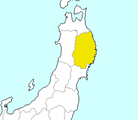
This is the largest prefecture on Honshu island.
Mountain ranges run from north to south across the eastern half and the western side of the prefecture.
Main towns are scattered along the valley between the mountain ranges.
Morioka is the central city and is the prefectural capital.
It has been selected as one of the "Places to Go" by The New York Times.
There is Hiraizumi which is a historic town built around the 12th century.
This is an area that a powerful local clan of that era built as an ideal land.
And, there is Tono city known for its Japanese folktales and traditional rural landscapes.
The entire east coast of the prefecture faces the Pacific Ocean directly.
That long coastline is known as the Sanriku Coast and features many scenic spots.
In winter, the mountainous area in the west part has heavy snowfall, but the central and eastern areas receive relatively little snow.
Akita Prefecture
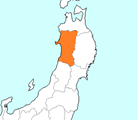
The west coast faces the Sea of Japan, and there is Akita city which is the prefectural capital at approximately its center.
Oga Peninsula pushes out into the Sea of Japan, and Oga city is located there.
It is known for a unique and unusual festival called "Namahage".
In the inland area, there is Kakunodate town with its district of samurai residences.
Lake Tazawa known for its mystical scenery.
It snows heavily in winter, but the snowfall is particularly heavy in mountainous areas.
Yokote city located inland is famous for "Kamakura" which is a traditional festival featuring snow domes.
It also features local traditional dishes such as "Kiritanpo" and "Shottsuru" hot pot.
Miyagi Prefecture
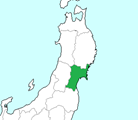
Sendai is the largest city in Tohoku region with a population of over one million.
This city is in the center of the prefecture.
As the powerful warlord Date Masamune built a castle in 1601 and the town flourished.
There are numerous sites associated with him.
The eastern side of the prefecture faces the Pacific Ocean.
Just to the northeast of Sendai city lies Matsushima where many small islands are scattered throughout the bay, and they create a beautiful landscape.
The western part of the prefecture is mountainous, and the active volcano Mount Zao is located on the border with Yamagata Prefecture.
In the mountains of the north lies Naruko which is a hot spring resort known as a production center for "Kokeshi", simple and handcrafted wooden dolls.
In winter, there is little snowfall in urban and coastal areas.
But heavy snow falls in the mountains, and there are also ski resorts.
Yamagata Prefecture
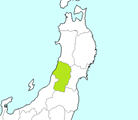
Mogami River flows northward from the mountainous region in the south of the prefecture, turns westward in the northern part, and flows into the Sea of Japan.
The entirety of Yamagata Prefecture lies within the basin of this great river.
Yamagata city is the central city and it is located in the middle reaches of the river.
Yonezawa located in the upstream region is a historic castle towns, and "Yonezawa beef" is known as a type of high-quality beef.
Around Shinjo city in the north, the river forms a gorge, so the visitors can enjoy a boat trip downstream.
Historic towns such as Sakata and Tsuruoka are scattered along the Sea of Japan coast near the river mouth.
Mount Zao is located on the border with Miyagi Prefecture and features hot springs and popular ski resorts.
In winter, there is little snowfall in urban and coastal areas.
But heavy snow falls in the mountains.
Fukushima Prefecture
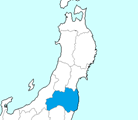
This is located at the southernmost tip of the Tohoku Region and borders the Kanto region where the capital is situated.
The eastern and western sides are mountainous, so some main cities are scattered across the central area and along the coatsline.
Fukushima city is the prefectural capital and it is located in the north and serves as a junction connecting to Sendai and Morioka on the Pacific side as well as Yamagata and Akita on the Sea of Japan side.
The western part of the prefecture is known as the mountainous Aizu region.
There are the tourist cities with unique traditional cultures such as Aizu-Wakamatsu and Kitakata in the basin.
You can reach the area by branching out from Koriyama located in the central part of the prefecture.
Along the way, you will find Mount Bandai which is a symbol of the prefecture and Lake Inawashiro.
In winter, Aizu region is an area with heavy snowfall, but other areas gets relatively little snow.
Transportation in Tohoku Region
Airport
Most major airport is Sendai Airport.
It has some international flights and many domestic flights.
Especially, the flights between Shin-Chitose (Sapporo), Chubu (Nagoya), Itami (Osaka), and Fukuoka airports are frequent.
There is a railway line from Sendai Airport to JR Sendai station.
It takes 17 minutes by rapid train and 25 minutes by local train.
And many buses to some other cities in Tohoku Region are operated.
There are some local airports in Tohoku Region.
Main airports are the following.
Railway
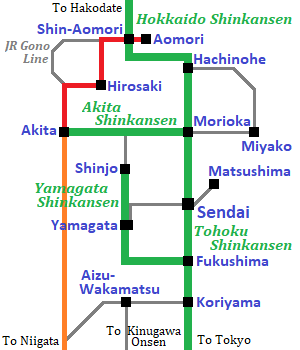
Main railway lines of JR in Tohoku Region.
The colored lines are the route of main limited express. Thin grey lines are local trains.
Shinkansen train comes from Tokyo to the main cities in Tohoku Region.
The trains are operated frequently, so it is very convenient.
By the fastest train, from Tokyo, 1.5 hours to Fukushima and Sendai, 2 hours 20 minutes to Morioka, 3 hours to Shin-Aomori, 2 hours 50 minutes to Yamagata, 3 hours and 50 minutes to Akita.
From Aomori, limited expresses are operated on the JR lines along the west coast of Tohoku Region.
And there are many local lines are in this region.
(Of course, there are some lines except the lines in above map.)
No night train is operated.